Tuesday, June 15, 2010

Charlie Chan Is Dead and Living in Honolulu


[Yunte Huang, 2007]

The Ohioan Earl Derr Biggers took a real Chinese man from Hawai`i, Chang Apana, and immortalized him as Charlie Chan; now a real Chinese man from Santa Barbara, Yunte Huang, has written the story of Earl Derr Biggers and his creation. That is to leave out at least one significant step, namely the declaration that Charlie Chan is Dead, not once but in two anthologies of Asian American literature edited by Jessica Hagedorn of the Philippines and New York City. If Asian American literature can be seen to emerge out of the death of Chan, then another way of looking at American history and culture rises from his ashes in Yunte Huang's Charlie Chan: The Untold Story of the Honorable Detective and his Rendezvous with American History, from Norton. Huang does several things in his book: he writes the biography of Chang Apana, who inspired Biggers's Charlie Chan; he situates Chang Apana in the 19th and 20th century history of Hawai`i; he writes about Biggers himself, as well as about the actors who played Chan, most importantly Warner Oland; and he uses these individual stories to tell the larger tale of Chinese immigration to the United States. If this were not enough, Huang also writes an autobiography of sorts, inscribing his own cultural, national, and linguistic histories into the narrative. And so the book opens with an awkward anecdote of a department secretary who tells Yunte Huang that he reminds her of Charlie Chan. By the end, the awkwardness of this anecdote is gone, and Huang has added Charlie Chan to his own version of The Making of Americans.

Let me start at the end of the book, since that is where I come in. A couple of years after Tinfish Press published Yunte's Cribs, a book of documentary/comedic poems (unusual combination) that featured wild linguistic leaps, he came to UH to participate in a conference on translation and to give a reading from his work. It was not an easy time for him, as his marriage was breaking up; I too began to flinch whenever his cell phone rang. He had little privacy during these phone calls because he and his then wife, both Chinese, spoke to one another in English. During a break in the conference proceedings and from the dreaded phone calls, we went on an excursion to the police department museum and then to the Chinese graveyard in Manoa, where (in a driving rain) we found Chang Apana's grave.

Yunte gave a talk on translation. That he is himself translated was more evident in his linguistic choices: speaking English to his Chinese wife, punning extravagantly in English to English speakers as if to point out, syllable by syllable, the strangeness of their own tongue. His Tinfish book is called Cribs, and is rather inevitably a doubling of "crib" as a manger or enclosure for children, and "crib" as a theft or plagiarism. Or, the translation of the book you're trying to read in the language you don't adequately know, which explains perhaps why so many copies of The Stranger by Albert Camus were bought by members of my high school French class. Where Yunte's translations from Chinese often concentrate less on "meaning" than on the "radicals" that accumulate into meaning, in Cribs he finds the radicals in English. He unpacks words according to their syllables, hence:

I want to
bask in your basket
toll in your toilet
ski on your skin
nap in your napkin
chat in your chateau
pace in your space

("For MIA, Made in America: A Song of Love that Goes Nowhere," 12)

Or he conjugates the word "it": "i / it / sit / shit / shite / hite / hit / it / t" (19).

And he performs a turnabout on the othering of Asians according to their "nese-ness":

"One day, in the street of New York City, he was asked by a white man who was apparently annoyed by his exotic appearance: 'What sort of 'nese are you? A Chinese, Japanese, or Javanese?' The famous author of The Book of Tea replied: 'What sort of 'key are you? A Yankee, donkey, or monkey?'" (59)

Words, then, at once mark the "foreigner" and provide ammunition for a counter-attack. I've written elsewhere on this blog about the writing of Goro Takano, a Japanese writer who wrote his novel With One More Step Ahead in an English at once odd and brilliant. One might say that the ark inside the mark of their English becomes a good part of their art. Charlie Chan's -isms, by way of Biggers's "translations" of Confucian philosophy, render estrangement into wisdom:

--Man who flirt with dynamite sometime fly with angels.
--Slippery man sometimes slip in own oil.
--Time only wasted when sprinkling perfume on a goat farm.
--The wise elephant does not seek to ape the butterfly.

These Chanisms resemble the sayings of Confucius run through a translation engine. How much Biggers knew of Chinese philosophy, if anything, is not made clear in Huang's account of him, but Huang knows a thing or two about Confucius and his western pupil, Ezra Pound. Biggers's "translations" of Confucian philosophy are comedic; Pound's translations are likely also askew, but they also infused modern American poetry with a Confucian pragmatism not unlike that of Ben Franklin. (See Josephine Park.) Without knowing, can we really tell which writer penned the following saying: "He who speaks without modesty will find it difficult to make his words good"?


[Chang Apana & Warner Oland, 1931]

The sayings of Charlie Chan, then, place him firmly in an American tradition, as well as the Chinese tradition that Biggers is mimicking. (If Biggers did not immerse himself in Apana's family's culture, then Warner Oland did, studying Chinese and traveling to China.) But of course he's also part of a more problematic American tradition, that of the Asian character as created by a white man for the entertainment of (mostly, one presumes) white people. Warner Oland is a Swedish minstrel, a yellow-faced white actor; one has only to remember the controversy over Miss Saigon's casting to realize how flammable the issue has been. It's here that Huang is at his best, weighing--with nearly Confucian dexterity--the racist underpinnings of Chan's popularity against the virtues of the novels and the movies they inspired. Among other things, Huang points out that Charlie Chan belongs in a pantheon of film noir detectives, and that, while Chinatowns have been used in film to denote crime and seediness, it was Chan who was responsible for rooting crime out. He distinguishes between the sinister character of Fu-Manchu, also played by Warner Oland, and the more benign Charlie Chan, in order to present Chan in a more favorable light. Ultimately, however, it's the link between the early 20th century Chang Apana/Charlie Chan and the late century immigrant, Yunte Huang, that makes the case most palpably.

Despite its deft combination of graceful prose and substantive research, there are problems with the book. The presentation of Hawai`i's history is more broad than deep (but is, at least, broad), and occasionally Huang uses terms more poetically than scientifically. My biggest concern was with his use of the term "pidgin" to describe the language that Chan speaks. Certainly Apana would have heard a lot of Hawaiian Creole English (or Pidgin) in his daily life, more than we hear now on the streets of Honolulu. But Biggers did not know pidgin and could not give Apana what might have been one of his languages to speak. To Huang, as to Biggers, "pidgin" refers to what is sometimes called "broken English" or to an idiosyncratic (idiolectical) version of "weird English." So, when Huang writes that he "adopted a poetic diction that imitates Charlie Chan's pidgin," or when he writes about Chan's "pidgin speech," he is not using the term as we use it in Hawai`i, where people actually do speak Pidgin. This will not be a problem for most general readers not in Hawai`i (what they don't know won't hurt them, I suppose) but I do wish he'd done more research on language, rather than plunking terms down on top of meanings they already bear. He also relies on Jack London as reference for Ko`olua the Leper, rather than going to Hawaiian sources. (Much more could be said on the reception of W.S. Merwin's The Folding Cliffs in Hawai`i, along these lines.)

In Cribs, Huang writes about the "paper-sons and paper-daughters" who came by boat to the United States from China. Entire villages memorized stories to tell the immigration officials in the US, officials who would try to trip them up. "The questions put to them were so absurdly detailed and irrelevant, that they would sometimes confuse the 'real' sons and daughters and not the paper ones" (40). Hence, immigrants would enter the country on crib-sheets. While Yunte Huang entered the country on a student visa, no doubt, he is also a "paper-son" of the USA. In that, he is like Charlie Chan, albeit a Chan who is literate, literary, and who has composed an important (auto)biography of the Chinese diaspora in the USA. Yunte Huang is a self-made Chan. And that, I hope, is progress.
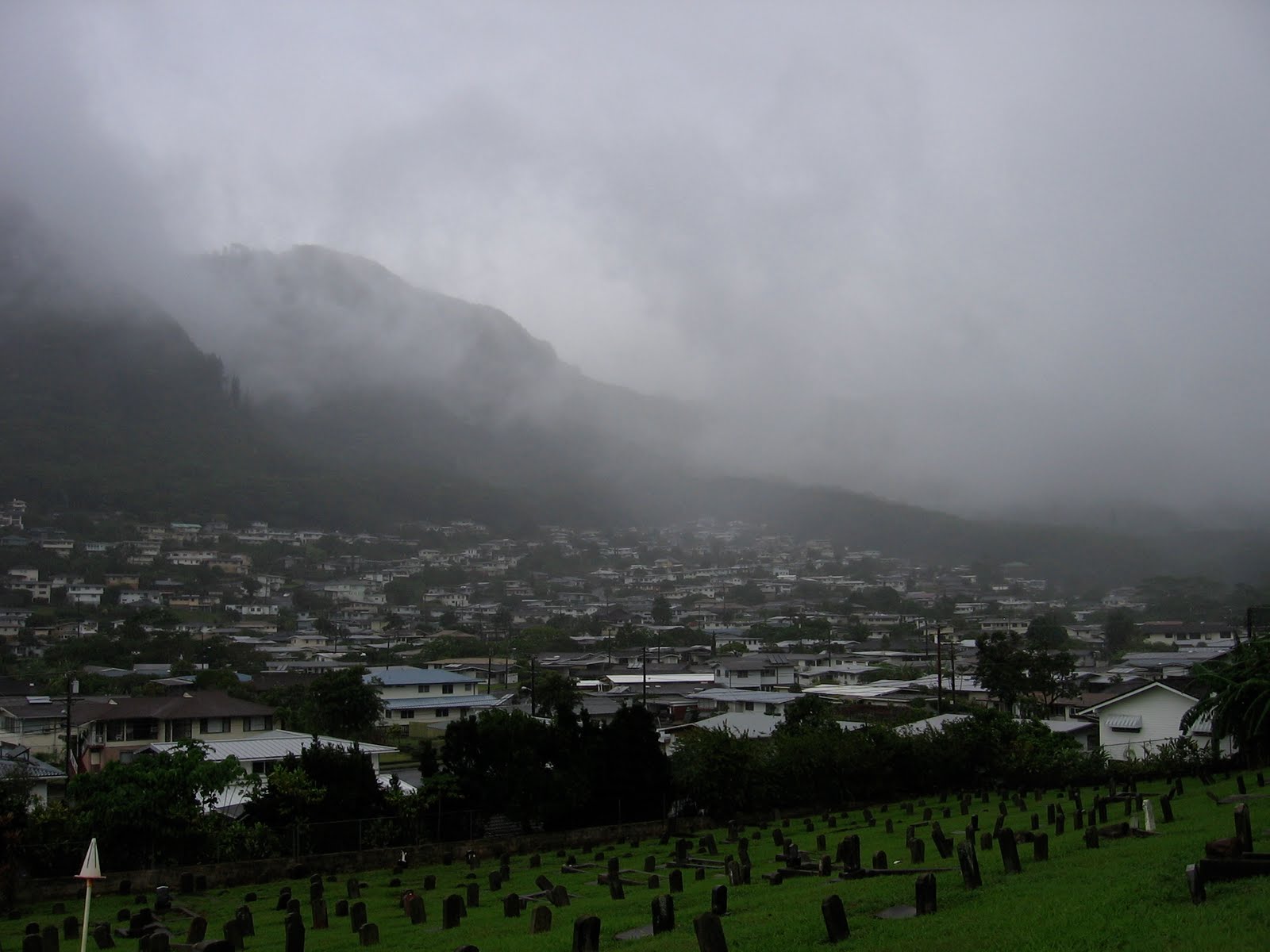

[Manoa Valley with the cemetery in the foreground, 2007]

Thursday, June 10, 2010

Alzheimer, Albrecht: Losing Is/Is Not Art

Alzheimer:

alt = old
als = as
al = all
heim = home
er = he

The google book about Alzheimer has random gaps, as if omission or forgetting were a sales pitch. I buy the book, Alzheimer: The Life of a Physician and the Career of a Disease, by Konrad & Ulrike Maurer, published in Germany in 1998 and by Columbia University Press in 2003. It is worth having, if for Figure 5.6 alone: "Alzheimer jumping rope." He is seen from the back. His jacket has caught the air like a petticoat; his arms are extended like wings; one leg is missing, the one he has just guided over the rope extended by two women and a girl in long dresses.

His voice comes to us mostly in questions. He asks them of his patients. What is your name? What is your husband's name? What year is it? 5 x 7 is what? What am I holding in my hand? Where are you? Sometimes the answers work, often they do not, like bad keys. Sometimes the answer is that I was born this year. Sometimes the answer is I don't know. Sometimes the answer is I'm going to die. When did you get married? To which: "indeed, the woman lives on the same corridor."


Alzheimer's: to discover is to own. The Amerigo Vespuci of forgetting. His exquisitely drawn maps of neurofibrils and brain plaque. An exactitude that meets its unraveling in "softness of the brain."

Auguste D. was his dinghy, his craft, his vessel, the Matson container ship to his idea. Auguste D. was jealous of her husband, a railroad clerk, forgot how to cook, screamed constantly, soiled herself, lost weight. When she died, he received her brain; he drew its tendrils, its blockages, its shrinkage. On her last day she "was very loud," was "very dazed," had ulcerated skin, pneumonia in both lobes. She died at quarter to 6. She had been ill for four and a half years. Her husband could not make his payments at the end. Dr. Alois Alzheimer paid.

With her free hand,
she swats at me, screams,
Stop it. Leave me here to die.

That was the day Malaika King Albrecht's mother forgot how to get out of the car. Al = all. Brecht = alienation of the audience, Bertolt. Durer: endure, duration.

Then she cusses, such a string of words.
For a moment I'm almost glad
she remembers them. (17)

There is little art to this losing. Losing objects, losing loved ones, these are artful. Losing your bedroom, losing the name for puppy, losing control of the car: these are not. What once was there is gone. What once was there reappears: "Learn to see dead family members / in the dark. Over / and over, call to them." (25)

While those of us who cannot see the dead must learn to forget, too. "Sometimes I / start to dial your number / before I remember." (35)

The final section of King Albrecht's small book is "Erasure," which re-presents some of the poems already printed in the text. The words are lighter, they are disappearing, save for a few bold ones, like "my mother" and "can't get back" and "Remember?" The poet cannot completely let her language go. There are still words where erasure is being enacted. Let them go. Erase them. They are gone. And yet their interference assures us there is no new poem, no Rad I Os to Paradise Lost, just occasional blurts of sense gathered from out of the white noise. Forgetting is not clean, or quiet.

Other absences, elisions: Alzheimer's colleague, Dr. Rudin (umlaut over the u). First mention on page 109: "The second scientific assistant, Swiss-born Ernst Rudin, because full professor of psychiatry in Munich in 1933 and a member of the specialist advisory council for population and racial policy in the Third Reich's Interior Ministry; he can be considered a pioneer of German 'Hereditary and Racial Care.'" (109)

Second mention: "As a scientist he distinguished himself primarily with works on the genealogy of schizophrenia. However, he continues to be remembered for writing the medical commentary on the Nazi law on the prevention of congenitally ill offspring, a law he also helped to implement."

Pioneer
Remembered

The ethics--the lack thereof--in these terms astonishes.

Wednesday, June 2, 2010

"She's welcome to her disease":_Stanzas in Meditation_ at the Alzheimer's home

Stanzas in Meditation I

[Television on. Background music.]


WATSH! WATSH! Where's my watsh?

Mom pushes the inhaler away.
Mom pushes the Ensure away.
Mom sits next to P, without the loving lean of P & G, yesterday.

P: "I'm fine. I'll wawawa dyu unnnnnn." She starts to cry.

"That makes me happy because lulu. Lulu, yes
I hope it's my father where it's cuz you kids don't have to be like that.
My back hurts: a little old lady that's me.
You wad it you dad it you got it you dat.
These are beautiful things.
I think it's perfect good,
if that's what we're getting it at [$5 off].
Turn him around you could get them back
because we need them; she wanted to was
helping fine with us help us, you don't have
too much it'll come.
I see it's over dere dere or not,
I just don't have a rose
because I might break it.
You done good
Your station but you're good
were nice were; I bet she's
welcome to her disease.
$5 off $25; where I going?"

"She's wagging in her tail
and she was feeling bad."

G. sucks on the black cloth foot of her doll with striped socks.

"DON'T PUT ANYTHING IN THE SOAP!"

G. chews on doll's foot.
"I'll lie down & this is so good this is so good
& bound to feel that way."

P: "W Y NNN
H I I I I I I I I I I
n n n n n n n n n
a a a a a a a a a a" [sound up, sound down]

G: "It's one lake that came out."

J: "This lady is a good lady, can't pretend.
Things have to be good. All ready for good people."
[Walks around the room, pats everyone on the arm.]

P: H H H H H A A H A A A A

G: "I have to take this table and shout!
We can read now!" [drops doll by dress to floor, falls asleep]

LIST OF CASUALTIES

dead
dead
dead
amputated
dead

N: "Barbie Barbie / Barbie Barbie / Barbie Barbie / (goes into the dining room) /
Barbie Barbie / Barbie Barbie / Barbie Barbie / etc."

P. gets up, shuffles, does a slow circular dance, trips on G's shoe, falls.

SIM 2

Dinner time. Only Martha refuses to move to the dining room. She watches
Leonardo di Caprio promise the Irish vote to the Sheriff. She will not move.

She will not move for B.
She will not move for Susan.
She will not move for the young African man.
She will not move for R.
She will not move for E.
She will not move for Susan.

Susan and Martha sit in the television room.
Martha wants her to go away.
Martha waves her arm when anyone comes near.
Leave Martha alone.
She will come later or she will not come at all.

R tells E to tell Susan to leave the room.
It's Susan's visit. She's never this angry. She always comes, if not
at first, then the second time you reach out for her hands.

B gets her into the dining room.
You can come back now.


SIM 3

G: "If you can go home, then grant it is!"

S comes to see his mother.
"You open da stoah?"
He doesn't have a store.
"You didn't open da stoah?"

F: "Not long, but over 7.
What do they put outside.
When people asked information,
They'd know it in opposition.
And that might we put on the was
a cover, he liked doing it too.
A bit from the door, so people
could cast away, he's resting him
causing him if he got ready.
He had one of the other
give a test one of the girls--
he dropped her on the floor
and it was me.

It's ok. The only time I talked to him.

Not against but sort of
they were having a good time
a nice church, he pays attention"

G: "Under my rough.
If you give her Laos, invilleagable."


SIM 4

A scream.
J has fallen.
"Get up!"

"Oh G O D [screams]"
Her head is bleeding.
"Oh God I'm dead.
I don't want to go
Oh I'm DEAD.
Oh God please help me."

"It's too late now."

"SCUM!
Get off my god damn"

P: "againagainagainagainagainagain."

S: "She didn't fall.
She was in somebody's room.
I don't know what happened.
What happened?"


An old woman is crying. (She always cries.)
She does not live in this lane.
Through her empty mouth she utters gutterals.
"Was ist los?"
"Menschen . . . Haus."
I walk her to her lane. She is crying. She is speaking
in words that sound German.
I knew I studied college German for a reason.
She is Dutch, I'm told.
Her memory box full of family smiles.
She is crying when I leave.

SIM 5

I tell Mom I am leaving.
"For good?"

Tuesday, June 1, 2010

NO CHEESE: June 1 in the Alzheimer's home

Monday. Common area: television, on. Music in background.

Act One: 10 a.m.

My mommy's having a baby! A baby, a baby, a baby!

G & P sit on the sofa.
P's eyes dark, deep, her face white as powder.
G has her head on P's right shoulder.

Look! Two babies. Twins! The babies, the babies, the babies!

"I can't hear a word you're saying."

"I said get out!"

"It's hard for her because she dddddd." [Hands flutter at waist]

P tries to stand up.
G tries to kiss her right arm.
P falls back.
They resume their position.

A vicious German defense brought the Allied advance to a halt at Casino.
People say I look 10 years younger; I look 10 years younger.

"Do you remember, World War II, mom?"
"No."

P begins to cry. She embraces K, who starts to take her for a walk.
"Where are your shoes? You need shoes to walk. You need to stop
crying or we can't go for a walk."

P & G resume positions on the couch.

I've been looking for a long time for someone to talk to and you're it because you can't understand one word I say to you. I want to talk about my girl back home. You I can tell the truth to

s s s s s s s - v v v v v v v v - s s s s
guh guh gonna go
There wasn't much time to think about women

P is cold, she's cold. She crosses her arms over pink & white striped blouse and a pink cross on a pink necklace. She wipes her cheeks on the bottom of her shirt.

"Marvelous! Good. Nothing." This woman, also in stripes, runs off with my mother's elbow straw from her can of Ensure. "How do you do your air?"

The luckiest people in the world


Act II: 4:30 p.m.


"Yer not talkin to yerself--I'm listenin'." [F to self]

Why oh why can't I
They love everyone but you on top of this f__ hill.

"She's a witch, I tell ya--that's what she is."

"Are you with the police again? Your mother asks me out for beers, but I think I'm too young for her. We had a luau the other day, the hula dancers had their tops on, very disappointing. When you go back to Hawai'i, send me a shrunken head, ok, but make sure the eyes are closed."

F: "He showed us that, I was wanting to go to the 5th floor; didn't know how to, must be the 1st floor where they cook stuff."

"They don't care about us."

"What's your first name?" Susan
"What's your name?" Susan
"Susan, and I still don't know it."
tangerine -- [gunfire] -- across the pond, yes she has
"Ruth, what is your name?"

"I'm Martha's daughter."
"I guess not."

"I'm going to do half a bugle,
Shiloh fast--
Is she going to win you, too?
But they'll be all right.
What we're going to do and have Ann's lot."

"I'D KICK HER ASS."

"They're all happy on this side
I got enough enough
Disquella, disk-la
That's the porty of the way."

"NO CHEESE!!!!"

"The name of the name of someone who is very cloned?
How is your doing?"

Mom: "don't bother me, don't bother me."

"Is your mom and dad doing it?"

"I'll make a noise."

J weeps over dinner. Her neighbor says:
"You're one of my favorite people."

"I lost my keys."
"That was peas, too."

"4 5 5 5 5 5
Her story is see you in a better place."

"You're the classiest gal in the whole world.
Don't be frightened."

Maybe this time I'll

"I want to go to the police
yes yes yes
to do something."

"Please don't throw us out.
Don't shut us off, please."

"I want to GET OUT,
what they're doing to me
NO NO."


ACT III: After dinner

"Have you heard the one about the mushrooms?"

"Have you heard the one about the two carrots?"

Monday, May 31, 2010

Memorial Day at the Alzheimer's Home

[on television around the corner from the lunch room: The Devil's Brigade]

The speaker of most lines is an old woman with a New England accent. There is music in the background.

"I want to see my two younger rooms."

"You wouldn't expect her to pick your feet, would you?"

"Everyone has feelings."

"Just forget it!"

"My place--there--they didn't give you--gauze--because she didn't really want to do it--maybe it was her daughter--which would be who--give it all back to her and . . . house, yeah, had it described, especially."

"I think legally they can't do that."

P enters on the arm of a social worker. P's face is blue, her shirt is blue. P still moans, though more quietly than last time. The swelling's gone down, I'm told. Are you upset about something, the social worker asks her, after they sit at the window.

"Every boy that you are."

Don't eat the ice. She eats the ice. Moves a cube from one plastic glass to another, her fingernails pink, like mom's. Her neighbor who doesn't speak indicates there's something wrong. She pushes back the table cloth, lifts her glass, tries to place it in her neighbor's bowl of pear slices.

"Candy. We've been a single and a diamond. Have to get a new job. A sensitive person. They have squares and they have one place to another."

Children. Children who need other children. And yet letting our grown up pride. Like children.

"That jacket, 12, try to change, 18 is it?"

People who need people are the luckiest people in the world. One very special person, your soul, half and now you're whole, the luckiest people in the world.

"Look over that car talking."

"NO CHEESE!"

I'm in love again and the feelings. Yes. And I know what to do.

"Pay for it--cash.
Another one she did. I know she made she seemed to travel 7. Yes she said, just the one."

My love went to London, left not returned, I'm going to London.

"The first guy. After I, you were, yes I was surprised.
Avoid 5.
1, 2, and then oy 5.
They get I don't"

There's a story told
To love
easy to learn women promise
She never sighed or cried.


Think so I put that on before I finished it
Her engine and I think it's moving" (regards sweet potato from above, below).

Every rolling stone
Home sweet home

I'm a rolling stone until today

"That's what it was they, they told her
We did we saw it
8 books 8 hours the time we spent.
They were forced to visit
50 of age."

Railroad track
Taken on back
Why did I decide to go?


Mrs. L is Korean, translated from Japanese, lived in China. Speaks no language now. Her son a doctor, comes on the weekends, not this one.

WHY DO I ALWAYS GET THE SMALL PART?

"Sadie's pastor.
Werner's yeah."

ICE CREAM!!

God bless the child that's got his own.

"I haven't got a pan.
If I can get in 6 towns.
By color except by or black
I know she think she had her
(laughs) came up & says"

Something's bound to begin

I remember
My mother was at Anzio.


Tuesday, May 25, 2010

Illness & Insight: Nancy Gerber on Alzheimer's & Jill Bolte Taylor on Stroke


Until I read Nancy Gerber's chapbook-sized memoir of her mother's Alzheimer's yesterday, I hadn't thought through my own reasons for ending Dementia Blog at the point I first saw my mother settled into her Alzheimer's home. At the time I thought I would end the blog there because all else would become repetition--not poetic repetition, but dull repetition, like the repeated repetitions in this sentence. (Not insistence, Ms. Stein, just repetition.) But I thought again when I arrived at the last page of Nancy Gerber's My Mother's Keeper. Here is end of the final paragraph:

"When I am with my mother I feel completely alone. In a room filled with people--residents and staff--I am alone. I have entered the crawl space of Alzheimer's."

Her mother is safely in her home, if not at home. And so the narrative ends, not so much with the mother, but with a daughter whose sense of aloneness mimics--in some small way--the solitude of the Alzheimer's patient. (It's worth noting that all three books I'm writing about here, including my own, are about mothers and daughters at the point their roles reverse.)

So is it a mother's safety that causes us to close the page on her? Is it that admission into an Alzheimer's home is itself a marker of her self loss? So hard to write about someone who does not speak or interact or do much more than sit. Is it that without a "self" about whom to write (marked as dramatic, incapable, angry, confused) we stop writing? For Nancy Gerber, the last image of her mother that we have is one of her wearing clothes that had not been hers, but now belong to her because she wears them: "and then I remembered: laundry was done communally, and we had not sewn on nametapes as we'd been instructed. Those were not her clothes when she came in, but they were now." Or is it, less happily, that the Alzheimer's sufferer enters a space past poetry, past narrative, past art? (One student who read my Dementia Blog pronounced it too "aestheticizing" and I suspect this would be a tipping point for him. But for me, the aesthetic is so much a part of it, whatever "it" you mean--writing, losing language, imagining events and people, revising history away from fact and into fantasy, the "it" that remains when nothing else does.)

When I ended my first blog about my mother, it was out of relief that she had a place where she could not set fires or fail to eat or attack a caregiver. It was also out of a sense that I had nothing left to write. That last feeling has since proved false. If Alzheimer's is a long narrative, then it is one that continues well past its denouement; there are fewer moments of drama, fewer crises, fewer places where a writer might find meaning. It is a long farewell, like a film that cannot locate its own conclusion. But true to life, to death, it goes on.

I have continued to blog about my mother outside the book I wrote about her. But the blogging has moved from a direct focus on her, which anchored the book, to readings of documents about her and sketches about the other residents of her home, which appear occasionally on this blog. What moves me, keeps me from feeling the "crawl space of Alzheimer's" with which Gerber ends her story, is the work of the staff that cares for my mother and her peers. In the absence of much connection between her and me, one is found between me and her caregivers and her; we triangulate well. There is much to learn from the interactions of "normal" people with those whose lives are what Stevens called "of mere being," if "mere" is the word.

On a recent episode of Speaking of Faith with Krista Tippett, Dr. Alan Dienstag remarked that he is now less afraid of Alzheimer's than he was before he began treating Alzheimer's patients. While Americans fear this more than any other disease, he finds that his (advanced?) patients are not in pain, they are not anxious; it is their families who suffer. Where repetition may feel deadly to me when I visit my mother, repetition can be seen as a gift to her. She cannot remember that I sent flowers (though she's "sure they must have come"), but each time she sees a flower she smiles. I cannot say what her "now" is, but for her it lasts precisely because it does not stick to memory. The last time I visited I showed her on-line photographs of my in-laws' dogs. She smiled, engaged with the pictures more than she had with me for a couple of days.

In My Stroke of Insight, Jill Bolte Taylor has written more a book of practical Buddhism than of science. Her descriptions of what happens when you have a stroke are vivid, dramatic, doubtless of value to the scientific community. But the story that interests her more is that of losing her self and then revising it, of losing memory and then altering it. Or, more particularly, of maintaining an ability to lose herself anew. While I suspect that her divisions of self into left and right brains are simplistic in a scientific sense (what do I know?), she uses those divisions to map out a self perpetually working out differences between linear time, particularity, boundaries, ego, and work and time that is all present, in which particulars dissolve into universals, the ego gets put aside, and work doesn't get done. By the end of the book I was reminded of a college professor I had named Louis DuPre; he was a Belgian Catholic, a tiny man with little--but very spiffy--shoes. He would draw a line on the board to distinguish between our world and a transcendent one. Up was better than down. He would hector us by demanding to know why it was NOT a good thing to sit on an island and simply be. Between the shoes and the revaluing of time, I was hooked. Now I find him on-line. When asked to define the "spiritual" life, DuPre responds: "Such an attitude originates within the self; it is not derived from the force of inherited habits nor from people's tendency to yield to social pressure. To attain the religious life the believer must be alert to the inner voice."

For Taylor, that inner voice emerged out of the silence of her stroke. Her "left brain's" monkey mind stilled, she could sense a larger wholeness. She could sense this before she could again express it. Left brain now does the bidding of the right by taking notes on that recognition. Now I do not know which brain is left for an Alzheimer's patient, though I do recognize in my mother of a couple of years back the sense of there being a pleasurable "now," the now of flowers noticed over and again in the space of 20 minutes, or even the now that means she could not remember that we were there visiting her. Yes, this is something to fear; but no, it's not the worst that can happen. Those of us who remember become the stenographers of these moments of recognition. We, too, have our places in the Alzheimer's home. We are its visitors from the left brain.

I will be visiting my mother for several days at the end of this week and early the next. She had a bad fall several days ago, and we got the call at 2 a.m. (Hawai`i time . . .). But she recently failed to qualify for hospice care; her simple expression of disinterest in the outside world does not mean she's "actively dying." And so the story continues, or images that might be stories were they connected through histories linking her to her contemporaries, her to me, her to the world. Those flickers are also worth attending to. They may hint at a paradoxical wholeness amid the self's many losses.

[I found Nancy Gerber's book on the fine Alzheimer's poetry website run by Gary Glazner. I have not done it justice here, because it so provoked me into my own meditations, but it's well worth reading; the photographs are also quite moving, obliquely so.]

Friday, May 21, 2010

_KAILUA_ : The Book as Plural Pronoun


I spend a lot of time thinking about ways to un-link two intellectual and cultural movements now current at the University of Hawai`i. One involves the ongoing recovery of Hawaiian language, orature, literature, and culture, a project that has gained momentum since the 1970s. The other is a critique of Asian settler colonialism (by implication also White Settler Colonialism) set forth in Candace Fujikane's and Jonathan Okamura's recent anthology of essays, Asian Settler Colonialism: From Local Governance to the Habits of Everyday Life in Hawai`i. University of Hawai`i Press). When these two ways of thinking are linked, this happens: "You can’t talk about alliances between local non-Hawaiians and Hawaiians. If you’re not Hawaiian, you’re a settler and part of the colonial problem." If we cannot make alliances, then how are we to oppose the scourges of militarism, over-development, and an economy almost exclusively dependent on tourism, to say nothing of education, the losses of social services, and so on? If we cannot make alliances, then how can we celebrate culture(s) rather than argue issues of who came first? If the settler/native divide is seen as a permanent condition, then how can we together deal with Hawai`i's tragic and often criminal history?

A new book published by the Kailua Historical Society provides some clues as to how to celebrate Hawaiian culture, while decoupling that celebration (and grieving) from the divisiveness of "settler colonialism." In her introduction to the beautiful and incisive volume, Davianna Pōmaika`i McGregor describes the book this way: "There are memoirs and documents which introduce the reader to a succession of resident families who are Hawaiian, Haole, Portuguese, Chinese, and Japanese, military, and multiethnic." She then discusses the mo`olelo retold by Kahikina de Silva, stories that are used to critique contemporary Kailua, describing "the underlying message of this work" as "those who live in and enjoy Kailua should work together to re-connect with and care for the land and water resources of their ahupua`a. This involves a respect for the indigenous spiritual knowledge of the land and the Native Hawaiian ancestors who provided stewardship for the `āina (land)."

There are myriad directions to go with this book, but the one that drew me in was linguistic. (Another worth taking is photographic; not only are the archival photographs amazing, but so are contemporary photographs by the team of Piliāmo`o, or Mark Hamasaki and Kapulani Landgraf.) While I'm accustomed to reading experimental poetry that uses several languages at once, while I sometimes listen to gypsy punk by Gogol Bordello delivered in American English and Ukrainian Russian, and while the linguistic field of my daughter's soccer team is mixed Pidgin and Standard English, most of the non-fiction books I read are in one language. This book is different. While most of the essays are in English, the mo`olelo are cited in Hawaiian (`oiwi) only, and vast stretches of de Silva's text exists in a between-language, one that assumes prior knowledge of Hawai`i. While some Hawaiian phrases are put in quotations, hence, "With our persistent endeavor to 'nānā i ke kumu,' we ensure that the ensuing ponds and tributaries run clear" (Kahikina de Silva), most are not. Gone are the italics of old, or the quotation marks. What remains are sentences in which many of the nouns (at least) are Hawaiian. In introducing the selections from a traditional epic, Makalei ka Laau Pii Ona a ka I`a o Moa-ula-Nui-Akea i Kaulana, or "the story of the sudden loss and slow restoration of pono to Kailua," de Silva writes sentences like this one:

"As a piko, then, Kawainui joined the people of Kailua with their gods, their neighboring ahupua`a, and their own ali`i and fellow po`e kānaka."

Non-translation goes both ways, of course, suggesting at once the inability of English to convey Hawaiian cultural markers, even as it invites the non-Hawaiian speaking reader to learn these markers by way of context, not via a rote exchange of words. (There are perhaps metaphors of economy to be found here, as translation-by-exchange more resembles capital, while translation-by-example is a less abstract condition.) These sections of the book, marked by their appearance on goldenrod colored paper, record problems in governance among Hawaiians who lived in the Kailua area. In her retelling of the mo`olelo, de Silva critiques contemporary capitalist practices--those that are transforming Kailua a generic town of adobe-colored store fronts and a Whole Foods-to-be, rather than essentializing them as belonging to Haole, or Asian, "outsiders." "'Makalei' reminds us that each boundary is in fact a point of connection as much as it is one of separation; that ahupua`a, though self-sustaining, are necessarily cooperative entities; and that simply living on the land does not make one a contributing, symbiotic part of the land." The boundaries that connect are the ones to hold close.

My in-laws live in Lanikai, a section of Kailua that has, over the past several decades, been "discovered" by the rich and famous and by tourists. Where the once wide beach could be walked in solitude even when I first moved to Hawai`i (1990), it is now covered with sun bathers at most hours. The beach has shrunk; sea walls have taken their toll. If you want to avoid the crowds, you have to get there early; my mother-in-law takes her hour long morning swim before 6 a.m. most days. While you can find out on-line that Lanikai means "royal sea," Kailua tells us that its original name was Ka`ōhao. Lanikai, it seems, is the "real estate name," rather like Hawaii Kai on the other side of Makapu`u. This word means "fishing ground," so much of what follows is about fishing, including an interview with Linda Mahoe, married for many years to Solomon Kalapawai Majoe, Jr. who fished the area for decades. (Kalapawai is a name familiar to anyone who buys wine, beer, sandwiches or coffee from the store just off Kailua Road and close to the beach.) Jiro Tanabe's oral history is called, tellingly, "Kailua: When I Knew Where Everybody Lived." The photographs from the early 1900s show us why; there are a few small houses next to the beach, and a road (still there), even a sign (LANIKAI), but little more than that. Now you would see a line of fenced off mansions along the shore, and older single-wall houses farther in, remnants of the pre-discovery days.

The book's last chapter (before the "Afterword") concludes de Silva's retelling of "Ka Makalei A Kawainui"; she acknowledges the "odd choice" of Ka`ōhao as a place to restore and perpetuate Hawaiian sensibilities. True to the history, the story ends before it concludes well; a mystery remains of how to find a missing boy, "reconcile him and his honorable lineage" so that "Kailua will be restored." While de Silva notes that Samuel Keko`owai, who published the mo`ōlelo in 1922, had a target audience of Hawaiians who still spoke Hawaiian and "who were still immersed in their identity and culture," this publication opens that audience up to those who now live in Hawai`i. De Silva makes the stories public to "promote an awareness of the history of this ahupua`a and our individual places in that history." I take the pronoun to be inclusive, her non-translations of Hawaiian word-concepts to be the very boundaries that hold us close. The pronoun "we" is inevitably fragile; that is why it is so worth defending.

Contributors to the book include John Culliney, Carol Silva, Paul Brennan, Maya Saffery, Jane Allen, Diane C. Drigot, Deborah F. Dunn, Sally-Jo Keala-o-Anuenue Bowman, Brett Uprichard, Kihe de Silva, Charles "Doc" Burrows, and others. They range from scholars of Hawaiian culture and language to scientists to linguists to long-time residents of the area. Design by Barbara Pope Book Design. You can order the book here, by following the "purchase information" link. I purchased my copy at Bookends, Kailua.

A side note that is not one: While reading the section on Maunawili by Paul Brennan, I came upon the story of Princess Lili`uokalani's 1881 accident in Maunawili. She was later taken back to Honolulu on the steamer owned by a Waimanalo friend. In 1893 that friend, along with her friends in Maunawili, opposed the overthrow of Queen Liliu`okalani. One friend (John Adams Aolani Kuakini Cummins) was tried for treason in 1895 and plead guilty. His great-great-grandson coaches my daughter's soccer team.


[my son and mother-in-law on Lanikai Beach; behind them are the Mokaluas]